
According to Cohen (2022), values-based hiring is a new understanding in recruitment.

Therefore, knowing your leadership archetype (Daskal 2017), social style (Culbertson 2018), communication style and company culture preferences can help a person determine organisational fit.
Despite having traits of integrity, courage, loyalty and trust; the dominant voice of the imposter and self-doubt (Daskal 2017) can pull me into the shadow.
Furthermore, I tend to interpret the world on a personal basis, and focus on feelings and relationships (TRACOM n.d.). I work hard to be mindful of this. While this could be perceived as a barrier, I see an opportunity to be humble and continually evolve as a leader.
This critical reflection research project was undertaken as a part of the Graduate Certificate in Customer Success Management.
The task was to analyse personal effectiveness as a leader and reflect on capacity to build successful customer and stakeholder relationships within a specific organisation.
I chose Atlassian, and examined if the organisation is the right fit for my values and personal leadership style.
Final grade – 81% (High Distinction)
Atlassian company profile & leadership style
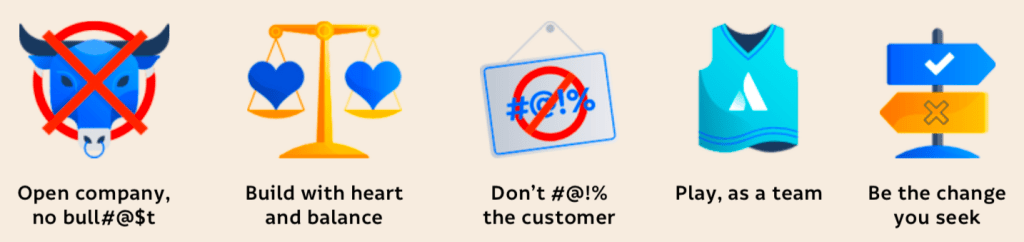
Founded in 2002 by Mike Cannon-Brookes and Scott Farquhar, Atlassian (n.d.) is a software company that believes in the power of teamwork and is fuelled by the mission to “unleash the potential of every team.”
With over 7,000 employees across 13 countries and 200,000+ customers, Atlassian’s core products are workflow and collaboration tools Jira, Confluence and Trello to name a few. Large enterprises like NASA, Twitter and Audi use Atlassian products. Their main competitors are Microsoft, Google, Salesforce and Zoho (Gartner n.d.).

Daisley (2020) notes that experiencing connection in a team, or “synchrony”, creates a positive feeling toward company culture, rather than values emblazoned on the office walls.
Atlassian appears to be a great working environment putting stakeholders first, with a strong set of values driving the culture.
However, a deeper look at Glassdoor (n.d.) reviews highlights a company with “toxic middle-management,” “broken work culture” and “a lot of bureaucracy at the top.”
The company’s dominant leadership style, or archetype, appears to be the Rebel and Inventor (Daskal 2017). This is evidenced by the content on the company website which speaks from a place of confidence, excellence, innovation, non-conformity and authenticity – traits of these archetypes. See figure one.
Appearing to align with a direct communication style and the Driver social style, Atlassian is bold, a leader in the technology industry, agile, energetic and assertive (Culbertson 2018).
I believe Atlassian’s culture of learning and enjoyment (Groysberg 2018) would expand my comfort zone. Characterised by an inventive and open-minded place to generate ideas, I would positively contribute to customer success strategies through my curious mind, innovative nature and desire to achieve win-win outcomes for all stakeholders.

According to OpenView Partners (n.d.), Atlassian uses a product-led growth model. This means their products are typically sold online and have less focus on the traditional sales model.
Products are designed for the end user and encourage value realisation early in the onboarding process. These are fundamental strategies that Atlassian uses to drive customer acquisition, product usage, retention and expansion (Busch 2022).
Customer success managers (CSMs) are technology and usage specialists. Working across multiple products and solutions, a CSM relates with a variety of internal stakeholders as a voice of the customer (Atlassian n.d.).
Pivoting to a distributed work policy in 2020, working at Atlassian presents an opportunity for people who live in regional areas, yet have a desire and capacity to work for a global technology company. Additionally, Atlassian’s focus on work management and agile methodologies aligns with a future career path I would like to pursue.
Critical analysis
A self-starter with an insatiable curiosity for life, I am driven by the philosophy “how you do anything, is how you do everything” (Caro 2019).
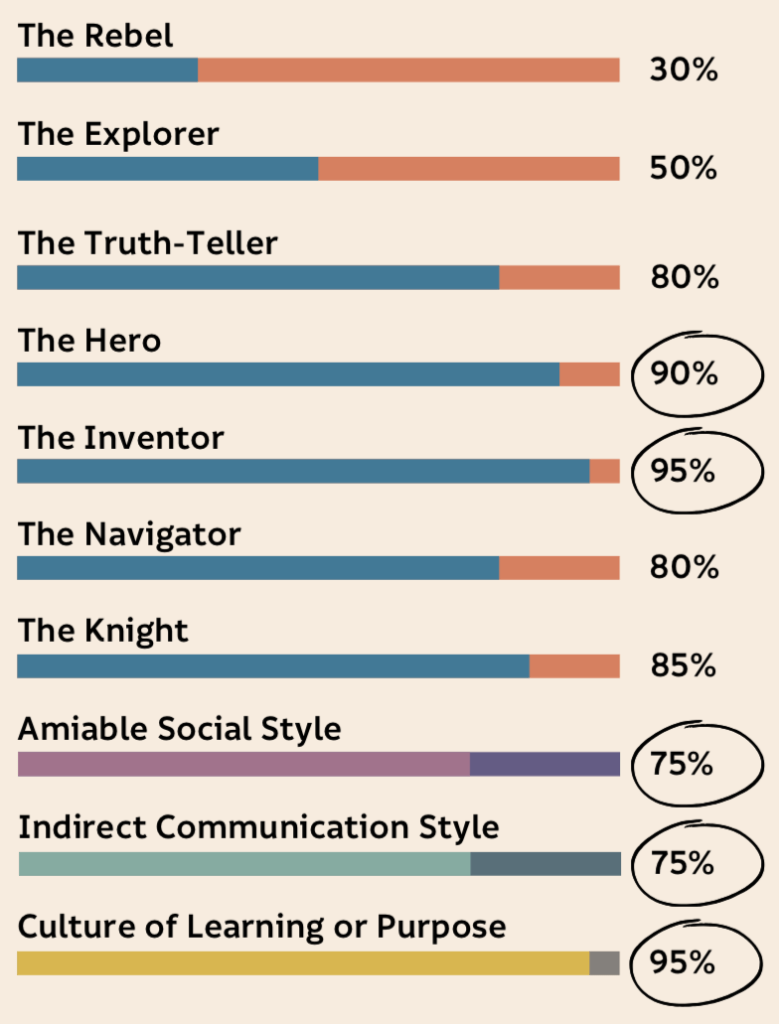
Identifying with the Inventor leadership archetype in the workplace, as shown in figure two, I am always improving processes, and never settle for anything less than excellence (Daskal 2017).
I use an indirect communication style and have an Amiable social style. Friendly, supportive and relationship focused (TRACOM n.d.), these qualities complement customer success strategies at Atlassian.
Self-reflection helps me approach conflict more wholeheartedly (Brown 2018), communicate decisively and respond with less emotion.
Having traversed what Joseph Campbell called “The Hero’s Journey” (Williams 2019), the Hero is a secondary workplace leadership style, characterised by courage, which strengthens over time (Daskal 2017).
My values, illustrated below, formed in 2006 through lived experience, continuous personal development and reflection.

A natural coach and champion of ideas and beliefs, the Navigator and Knight are tertiary leadership styles when managing a team.
There is an opportunity for improvement when in shadow with the Fixer and Mercenary (Daskal 2017). I tend to go to people’s rescue to avoid difficult conversations, and perceived suffering, or get defensive when armoured up (Brown 2018).
Understanding the importance of empathy in a customer success role, I naturally build trust through honesty, vulnerability and integrity. This complements Atlassian’s values of “Open Company, No Bull@#$t” and “Be The Change You Seek”.
As owner of a multiple six-figure hospitality business, courage as a leader deepened over the past four years. Especially during times of crisis like the 2019/2020 bushfires and the global pandemic.
I keep the Imposter (Daskal 2017) in check through self-reflection, awareness and growth mindset (Dweck 2016). This increases my confidence to run a business with a consistent 5-star online reputation and strong loyalty.
I feel happiest when I am working for an organisation that values authentic relationships, encourages autonomy and has purposeful goals.
I would thrive in a culture of purpose or learning, where leaders emphasise shared ideals, innovation and knowledge (Groysberg et al 2018).

I give my best self when I feel in-flow (Oppland 2016), connection with peers (Daisley 2020), and customers are delighted by my servant leadership (Tait 2020).
Appearing to improve the world through the work they do, Atlassian demonstrates they are for-profit-for- purpose by pledging to donate 1 percent of equity, time, product and profit to philanthropy (Farquhar 2014).
Speaking from an apparent place of authenticity, I like to believe that Atlassian leaders genuinely care for their employees. According to Price (2022), innovation, exploration, expansiveness and creativity is a part of the company mission. These are key characteristics of a culture of learning (Groysberg et al 2018), and another reason why I feel a values-alignment with the company.
As a leader I believe it is important to consistently check-in with yourself, face the shadow of self-doubt, rumble with vulnerability and be wholehearted (Brown 2018).
By focusing on strengths and deficits and engaging a growth mindset (Dweck 2016) you ensure your individuality complements a team or organisation. In turn, this will help achieve goals for the benefit of all stakeholders and ensure mutual success.
References:
Atlassian (n.d.) “Company page”, Atlassian website, accessed 4 October 2022. https://www.atlassian.com/company
Atlassian (n.d.) “Customer Success Manager”, Atlassian website, accessed 4 October 2022. https://www.atlassian.com/company/careers/detail/2c4a5a9d-230f-43f6-b846-970521595530
Atlassian (n.d.) “Values page”, Atlassian website, accessed 4 October 2022. https://www.atlassian.com/company/values
Brown B (2018) Dare to Lead: Brave Work, Tough Conversations, Whole Hearts, Random House, New York
Busch M (2022) 7 Product-Led Growth Companies Paving the Way in Tech Today, Amplitude website, accessed 22 October 2022. https://amplitude.com/blog/product-led-growth-companies
Caro C (2019) How You Do Anything Is How You Do Everything, Leadership, Forbes website, accessed 10 October 2022. https://www.forbes.com/sites/forbescoachescouncil/2019/01/04/how-you-do-anything-is-how-you-do-everything/?sh=2d07f2ab19c1
Clear J (n.d.) Core Values List, James Clear website, accessed 3 October 2022. https://jamesclear.com/core-values
Cohen A (2022) To Find Success at Work, Match Your Job With Your Personality, Businessweek + Work Shift, Bloomberg website, accessed 8 October 2022. https://www.bloomberg.com/news/articles/2022-09-23/why-do-i-hate-my-job-it-might-not-fit-your-personality
Csikszentmihalyi M (1990) Flow: The psychology of optimal experience, New York, NY: Random House.
Culbertson (Boyle) CJ (2018) Want to Influence Others? Find Out How They Interact, Leadership, Forbes website, accessed 10 October 2022. https://www.forbes.com/sites/forbescoachescouncil/2018/07/23/want-to-influence-others-find-out-how-they-interact/?sh=47f359b6153f
Daisley B (2020) Company Culture is a Myth. Instead, Get Small Teams in Sync. Entrepreneur website, accessed 18 October 2022. https://www.entrepreneur.com/growing-a-business/company-culture-is-a-myth-instead-get-small-teams-in-sync/347397
Daskal L (2017) The Seven Archetypes of Leadership (and the Gaps that Get in the Way of Greatness), Leader to Leader, 2017: 18-22, accessed 3 October 2022. https://doi.org/10.1002/ltl.20316
Dweck C (2016) What Having a “Growth Mindset” Actually Means, Managing Yourself, Harvard Business Review website, accessed 8 October 2022. https://hbr.org/2016/01/what-having-a-growth-mindset-actually-means
Farquhar S (2014) Pledge 1%: a new model for corporate philanthropy, Company News, Atlassian website, accessed 13 October 2022. https://www.atlassian.com/blog/announcements/corporate-philanthropy-pledge-1-percent
Gartner (n.d.) “Atlassian Alternatives”, Gartner Peer Insights website, accessed 11 October 2022. https://www.gartner.com/reviews/market/workplace-social-software/vendor/atlassian/alternatives
Glassdoor (n.d.) “Atlassian Employee Reviews”, Glassdoor website, accessed 10 October 2022. https://www.glassdoor.com.au/Reviews/Atlassian-Reviews-E115699.htm
Groysberg B et al (2018) The Leader’s Guide to Corporate Culture, Organizational Culture, Harvard Business Review website, accessed 13 October 2022. https://hbr.org/2018/01/the-leaders-guide-to-corporate-culture
Kets de Vries MFR (2013) The Eight Archetypes of Leadership, Leadership, Harvard Business Review website, accessed 3 October 2022. https://hbr.org/2013/12/the-eight-archetypes-of-leadership
Lofgren J (2019) Four Skills You Need for Courageous Leadership, Leadership, Forbes website, accessed 3 October 2022. https://www.forbes.com/sites/forbescoachescouncil/2019/01/10/four-skills-you-need-for-courageous-leadership/?sh=483e1f8513f3
Morgan B (2018) How Leadership Development Impacts Customer Experience, CMO Network, Forbes website, accessed 3 October 2022. https://www.forbes.com/sites/blakemorgan/2018/04/03/how-leadership-development-impacts-customer-experience/?sh=188b3b13117e
OpenView Partners (n.d.) Product-Led Growth, OpenView Partners website, accessed 23 October 2022. https://openviewpartners.com/product-led-growth/
Oppland M (2016) 8 Traits of Flow According to Mihaly Csikszentmihalyi, Positive Psychology website, accessed 10 October 2022. https://positivepsychology.com/mihaly-csikszentmihalyi-father-of-flow/
Price D (2022) What does a culture of innovation really look like? Work Life, Inside Atlassian, Atlassian website, accessed 13 October 2022. https://www.atlassian.com/blog/inside-atlassian/how-to-build-culture-of-innovation-every-day
Schembra C (2017) 7 Archetypes of a Good Leader, Thrive Global Medium website, accessed 3 October 2022. https://medium.com/thrive-global/7-archetypes-of-a-good-leader-d1275fbd5f2a
Sharma R (2022) 12 Voice of the Customer Methodologies to Generate a Gold Mine of Customer Feedback, HubSpot website, accessed 10 October 2022. https://blog.hubspot.com/service/voice-of-the-customer-methodologies
Sinek S (2009) How Great Leaders Inspire Action, TEDX website, accessed 18 October 2022. https://www.ted.com/talks/simon_sinek_how_great_leaders_inspire_action
Tait B (2020) Traditional Leadership vs Servant Leadership, Leadership, Forbes website, accessed 20 October 2022. https://www.forbes.com/sites/forbescoachescouncil/2020/03/11/traditional-leadership-vs-servant-leadership/?sh=394f942e451e
Tousley S (n.d.) Customer Feedback Strategy: The Only Guide You’ll Ever Need, HubSpot website, accessed 3 October 2022. https://www.hubspot.com/customer-feedback
TRACOM (n.d.) Social Style®: The Amiable Style, Social Style® Model, TRACOM website, accessed 20 October 2022. https://tracom.com/social-style-training/model/amiable-style
Wiest B (2018) How to Get into the “Zone of Genius” and Unlock Your Highest Potential, Forbeswomen, Forbes website, accessed 4 October 2022. https://www.forbes.com/sites/briannawiest/2018/09/26/how-to-get-into-the-zone-of-genius-and-unlock-your-highest-potential/?sh=1eb38b365672
Williams C (2019) ‘The Hero’s Journey: A Mudmap for Change’. Journal of Humanistic Psychology, 59(4), 522–539, accessed 4 October 2022. https://doi-org.ezproxy.lib.rmit.edu.au/10.1177/0022167817705499
Zoltners AA et al (2019) What is a Customer Success Manager?, Sales and Marketing, Harvard Business Review website, accessed 29 September 2022. https://hbr.org/2019/11/what-is-a-customer-success-manager


Leave a Reply